
Invisible stainproof hard sealer protection that stops staining and etching while preserving marble's natural beauty.
Keep the natural look. Add the protection.
Learn how professional stainproofing can transform your marble surfaces.
The truth about what's quietly destroying your stone — and the only way to stop it.
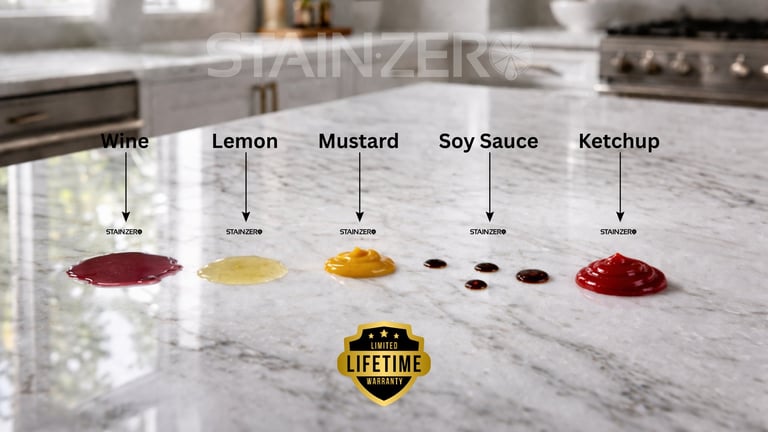
Common household acids on unprotected marble: wine, lemon, mustard, soy sauce, ketchup
A cids from everyday substances — lemon juice, wine, coffee, vinegar, tomato sauce, even water — leave permanent etching marks that don't wipe away. What begins as a dull spot becomes a permanent scar in the stone.
Marble etching happens when acidic substances react with the calcium carbonate in the stone, creating rough, dull craters. Once that reaction occurs, the stone typically requires professional refinishing — an expensive, disruptive process that involves grinding down the surface.
"It's not a matter of if your marble will etch — it's a matter of when."
The Inevitable Truth
Prevention is the only real solution. Every unprotected marble surface will eventually fall victim. The question isn't whether to protect — it's how soon you can.
StainZero Anti-Etch Protection For
Invisible protection. Permanent peace of mind. The anti-etch revolution your marble deserves.
S tainZero is an invisible, ultra-thin, non-yellowing anti-etch coating that provides permanent resistance against etching, staining, water spots, and ring marks — without compromising the stone's natural beauty.
It does not alter the natural look or texture of your marble. You keep the beauty — we add the protection. This is the definitive marble sealer for preventing acid damage, trusted by homeowners who refuse to live in fear of their countertops.
"You keep the beauty.
We add the
protection."
The StainZero Promise
Designed for homeowners who want peace of mind, not stress. Professional anti-etch protection — Invisible Film has a 5-year warranty, Anti-Etch Sealer carries a 10+ year warranty. Stops all acid damage from wine, lemon, coffee, vinegar, and more.
StainZero applied — invisible, non-yellowing, permanent anti-etch barrier
Zero staining and zero etching — no more ring marks, water spots or surface damage from food and liquid.
You should not expect a new finish or a new color, because StainZero is invisible and ultra-thin with no visible coating.
You're buying prevention. You keep the look you love without stressing over every spill.
Not all protection is equal. Here's what separates a real solution from a temporary fix.
Regular Sealers
Regular sealers mainly slow down absorption. They don't stop etching — they're a raincoat in a monsoon.
StainZero™
StainZero addresses both staining AND etch marks — comprehensive protection that actually works.
"You're not just buying a sealer.
You're buying
peace of mind."
Three protection options to fit your needs, budget, and how you use your marble surfaces.
Essential Protection
Traditional sealer that absorbs into stone pores to slow liquid penetration. Helps reduce staining but does NOT protect against acid etching.
Does NOT protect against acid etching
Reapplication recommended: 1-2 years
Advanced Coverage
A removable protective film that creates a physical barrier over the marble surface, protecting against acids, stains, and everyday wear.
5-Year Warranty
For the Invisible Film
Professional application included
Maximum Protection
An ultra-thin, invisible protective coating that bonds to the marble surface, creating a durable shield against both stains and etching.
10+ Year Warranty
For the Anti-Etch Sealer
Recommended for high-use kitchens
Always use coasters under glasses (especially acidic drinks like citrus juices and wine) and trivets under hot pots and pans.
Don't let spills sit on marble — the longer acidic substances remain on the surface, the more likely they are to cause etching.
Never use vinegar, lemon juice, or acidic cleaners on marble. Use only pH-neutral cleaners specifically formulated for natural stone.
Consider professional protection options like StainZero Hard Sealer or Film Protection for durable barrier against etching and staining.
Have your marble countertops professionally inspected and maintained annually to identify early signs of damage.
No. StainZero is invisible and ultra-thin. You should not expect a new finish or a new color. Your marble will look exactly the same — just better protected.
Regular sealers mainly slow down absorption — they don't stop etching. StainZero addresses both staining AND etch marks for comprehensive protection.
StainZero is designed for long-term durability. Depending on the protection level you choose, it can last 5 years, 10+ years, or permanently with our premium hard sealer option. All installations come with a warranty.
We protect all marble surfaces including kitchen countertops, bathroom vanities, bar tops, dining tables, fireplace surrounds, and more.
Simply fill out the form below or call us directly. We'll schedule a free on-site assessment to evaluate your marble and provide a custom quote.
Comprehensive protection against both staining and etching from acidic substances.
No visible coating. Maintains the natural look and texture of your marble.
Stays clear over time. No yellowing or discoloration even years later.
Engineered to withstand high-traffic use and daily wear and tear.
Warranty matters because it shifts the risk. If the surface stains or etches under warranty, we come back and fix it — so you're not paying again to repair something that should have been protected.
For the Invisible Film — standard coverage for peace of mind.
For the Anti-Etch Sealer — premium coverage for long-term protection.
We stand behind our work — period.
Stop worrying about spills and etches. Let our experts help you find the right protection solution for your marble surfaces.
Fill out the form below and we'll get back to you within 1 hour during business hours.